



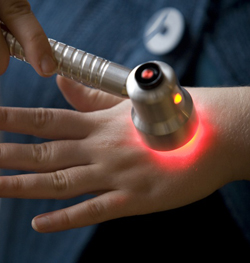
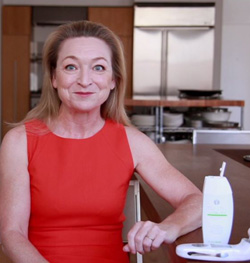
I have become a big fan of LED light therapy with monthly salon sessions and top ups at home with my Truth Vitality Lux Renew with LED and Ultrasound ($279 in the shop). My husband is more than a little bemused by these rituals and a few months ago, he asked my how LED works to rejuvenate the skin. It's a good question and, until recently, it was poorly understood. Scientists could see the results, but couldn't explain them. Apologies for the long post, but it turns out that LED is complex and controversial.
Granted that even NASA said good things about LED: “Low-energy photon irradiation by light in the far-red to near-IR spectral range with low-energy (LLLT) lasers or LED arrays has been found to modulate various biological processes in cell culture and animal models. This phenomenon of photobiomodulation has been applied clinically in the treatment of soft tissue injuries and the acceleration of wound healing."
But even NASA was a bit vague about the whys and hows. Around 2003, it was being described as similar to photosynthesis. A Harvard paper summed it up in 2006: "The use of low levels of visible or near infrared light for reducing pain, inflammation and edema, promoting healin of wounds, deeper tissues and nerves, and preventing tissue damage has been known for almost forty years since the invention of lasers. Originally thought to be a peculiar property of laser light (soft or cold lasers), the subject has now broadened to include photobiomodulation and photobiostimulation using non-coherent light. Despite many reports of positive findings from experiments conducted in vitro, in animal models and in randomized controlled clinical trials, LLLT remains controversial."
The controversy was due to the mechanism of how LED or low level light therapy (LLL) works being a bit of mystery. Although researchers, such as these in Denmark, established that it does boost collagen. The second issue — contributing to the mystery — is that experiments would vary things like wavelength, pulse density and goodness knows what making it difficult to see replicated conclusions.
Then came along some research that suggests that it has to do with water. Researchers in Germany concluded that "by targeting water layers on elastin, facial wrinkle levels could be significantly reduced by irradiation of the skin with visible light, which was found to interact with interfacial water layers on model substrates."
Some doctors believe that photons are absorbed by the mitochondria in skin cells. "Consequently, electron transport, adenosine triphosphate nitric oxide release, blood flow, reactive oxygen species increase, and diverse signaling pathways are activated" (Source).
So there we have it. But not so fast. I was pulling all this information together when, the other day, I received an email from Angela with a link to an article that said that researchers found that LED did a good job on wrinkles but also the exposure to intense LED light generated high levels of reactive oxygen species, as byproducts that can potentially damage cells. Eeek!
To combat that effect, the article went on to say the researchers combined the LED with a potent antioxidant in green tea extract called epigallocatechin gallate. And all was well again. Hmm. What was going on? And, as Angela, reasonably asked, would our Baby Quasar's be destroying our cells?
The researchers turned out to be none other than the Germans who came up with the water theory mentioned above. I went back to look at their research paper and couldn't find a single mention of reactive oxygen species being generated or epigallocatechin gallate. Nor could I find any other research papers of theirs that did - only the article (which didn't have any links back to the research). Perhaps the article was planted by the green tea council.
Most of the science seems to agree that light therapy increases production of ATP (the energy engine of cells) and the modulation of reactive oxygen species and that, according to that Harvard paper mentioned above, "these effects in turn lead to increased cell proliferation and migration (particularly by fibroblasts), modulation in levels of cytokines, growth factors and inflammatory mediators, and increased tissue oxygenation."
Then I found some research that focused specifically "on the role of reactive oxygen species in the cellular and tissue effects of low level light therapy (LLLT)." It said that ROS scavengers, antioxidants and ROS quenchers block many LLLT processes. However, it concluded that "it may be the case that LLLT can be pro-oxidant in the short-term, but anti-oxidant in the long-term."
This chimes with a Chinese study that suggests there may be something to the green tea theory. It says that ROS can be activated by LED but this is significantly diminished by applying vitamin C or superoxide dismutase.
My take on all of this is that the benefits of LED are well-documented and wide-ranging. However, the light can also signal scavengers in the short-term, but that these are ultimately overthrown by the antioxidant activity that the light stimulates. On the other hand, using a topical antioxidant seems to speed up that process. So I am definitely going to continue enjoying the benefits of my Lux Renew, but will be sure to slather on my favorite serum first.
Read more:
Blue Light May Defeat Your Acne
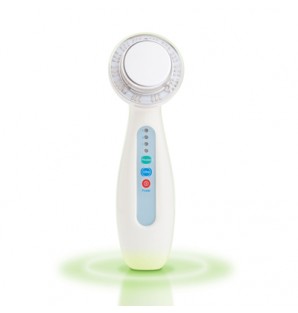
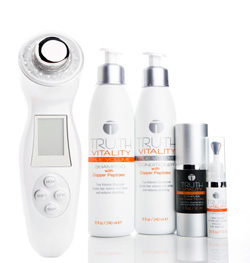
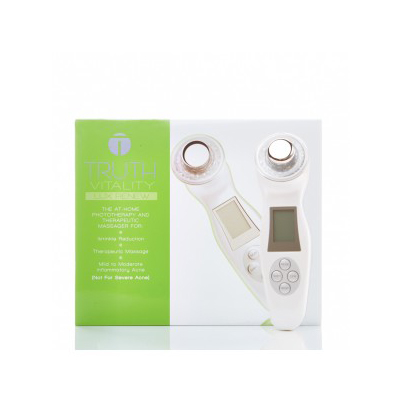
Truth Vitality Lux Renew with LED and Ultrasound
In the dark about amber LED light therapy










 Loading...
May 3, 2019
by Sam
What happened to your husbands idea of the grow light?
April 25, 2018
by Marta
Em, as the article mentioned the antioxidants green tea and vitamin are known to be helpful with LED. If you can't use prior to using your device then apply the antioxidant serum immediately afterwards.
April 24, 2018
by em
Marta, which antioxidant product should I apply prior to using LED light? And is it okay to do this even if the manufacturer suggests using the device on cleansed skin?
January 14, 2018
by jj
it would be awesome for you to review the celluma device that is flexible for anti aging etc....i have been on the fence whether to buy one or not....it is big and flexible which makes it very appealing but it says use no creams etc b4 you use it and it is suppose to have 3strengths of llt and even number of each in unit
November 2, 2016
by Marta
Hi Silvia, while there are people online buying cheap LED Grow lamps and using them for anti-aging, I would be cautious. The first thing to note is that serious plant growers are careful about using LED as, until recently they haven't performed well. LED Grow lights need to be in nm 400-700 to grow plants - that is roughly in the violet/blue through red spectrum. This is also the within the typical range for skincare. However, Grow lights have tended to be inaccurately arrayed (this is said to be improving) and do not give the correct nms. Furthermore, they don't work in short, efficient bursts like facial devices. It is unknown how long they need to be used for any one session. Good, properly arrayed lights for plants are as expensive as facial devices. Finally, they have not been tested or cleared by the FDA as safe and effective. Short answer, take your chances.
November 2, 2016
by Silvia
It would be nice what do you think about using Grow led light on skin. They are actually used for growing plants. And many people on line are using this lights for wrinkles and fine lines. Please is you can comment on this subject. Thank you.
October 19, 2016
by kelsey
I actually highly recommend the LED light. I am an actress, and do photoshoots and video shoots. Before every shoot I do the LED Light Treatment and I use the Somaluxe Face Wash before the photoshoot. The combination of both makes my skin flawless and look perfect on camera. Highly recommend
October 4, 2013
by Angie
Boy Kim sure got on her soap box & gave a tongue lashing to Marta. That was rude & judgmental. The comma separated her from the scientists. i.e. scientists,(comma), like me... Rewording it so you understand. And what she was sayin so you can understand it better,,, meaning the scientists as well as me is what she was trying to get across.
August 20, 2013
by Danielle
Avoid Prolight Aesthetics LED light.
On March 3, 2011, I purchased a Green Prolight from Prolight Aesthetics International. The device carries a lifetime warranty. I spent more on the Prolight than similar products would cost because I thought it would be a better device.
Instead, bulbs on the Prolight began to malfunction one-by-one with less than 60 days use. I received a second and third Prolight, all three had malfunctioning parts.
The problem with Prolight Aesthetics’s Green Light is two-fold:
1. Bulbs continually malfunction
2. Green Prolight does not do as advertised (decrease hyperpigmentation)
Prolight Aesthetics advertises the Green Prolight as follows:
"The specific wavelength frequencies incorporated in the ProLight Green act directly on melanocytes and hyperpigmentation, decreasing melanin production by 30% to 50%, helping to stimulate melanin deposit breakdown in epidermal layers of the skin."
I have seen no results at all with the Green Prolight. I would have been happy with even a 10% improvement but there is none.
Spent over $400 total on Prolight Aesthetics's device (was not refunded shipping for the multiple times had to return device due to malfunctioning parts).
Owner Rita Page of Prolight Aesthetics is currently not answering emails. Does not seem concerned that Green Prolight does not work.
December 8, 2012
by maria
hi - sorry to report but I will never use any light therapy near my face anymore! I did have IPL (as i commented on another post--pelleve post) and i did have grooves show up around my eyes and diminished fat - very obviously. I now wear glasses to camoflage and i'm okay with that as the glasses are actually flattering but i'm not okay with damaging my skin and i'm not okay that the manufacturers, FDA, or MDs don't warn people of this danger in advance and let them make the decision of taking this risk! I think it's awful and i'd sue but i'm sure it would just make me feel worse.
August 8, 2012
by Marta
Hello again Kim. The sentence read that "scientists, like me, could see the results...." Meaning both scientists and I have seen results etc, not that I am a scientist. However, I have removed the words "like me" since it confused you and, obviously, I am not a scientist.
August 8, 2012
by Kim
Forgive me, but were you joking when you referred to yourself as a scientist near the beginning of this piece? Are you? I believe in personal responsibility and, according to information about you, it mentions nothing of you working as a researcher in any scientific field. In fact, you seem to have a media/marketing background. If you are throwing the word, scientist, around, and referring to self-education, which is wonderful, but obviously, not the same as a scientist who has been trained, it makes a mockery of those who actually are scientists, who have dedicated many years of their life and much money to their education and their research, "like me", actually. However, if you truly are a scientist, then my apologies. I just see too much of this on the internet.
February 22, 2012
by Ann R
Hi Jayne, I attended a taping of the Martha Stewart show yesterday when she had a dermatologist who does Ultherapy which they demonstrated on one of Martha's assistants. The results were remarkable so saving up for it may be worth it! Look for the episode entitled The Skin Show, they didn't give us an air date. It may help you make a decision. Good luck!
February 22, 2012
by Jayne
i keep reading all this information early. I'm 45 and due to serious hormone problems as well as thyroid and adrenal, i have aged quite a bit in the last 4-5 years (i also had 2 children during this time)
SO, what i'm getting as is... Does anyone know what the best way of tightening my skin would be. Would an at home LED device do the trick or do i need to save up for Ulthera (which is new but i'm nervous because there is no guarantee)
I would love some advice.
Thanks for all the info. and thanks for your time
Jayne.
September 20, 2011
by Susan
Dear Marta:
You provide a wonderful and much needed service, and I am a loyal fan.
Could you please review the Baby Quasar Md. It is supposed to be three times more effective/powerful than the Baby Quasar Red, which I know you recommend. It is also quite expensive, so I would love your analysis before I consider purchasing it.
Thank you so much for your consideration and for the very valuable and educational service you provide.
Sincerely,
Susan Jacobs
September 19, 2011
by Jan
One more note regarding this unit.....the 2 panels are removable therefore I also use them on an achy elbow and anything else the creaks or causes me grief. It also makes it easy to just lay on the area wanting to be treated, so I literally lay on the dog's crib size memory foam bed and place the DPL unit on my face, neck and arm as needed. The dog doesn't mind because she's laying up on MY bed!!!!
September 19, 2011
by Jan
I utilize the DPL light therapy unit. I was using a cheapy Pretika handheld which provided some result, but what I discovered was I didn't like to hold the darn thing and the coverage area was too small to be time effecient. I have had the DPL unit for a couple months and must be honest in that I didn't begin diligently using it until about 3 weeks ago. I am 50 and will admit to having excellent genes and great skin. However....the past 2 years have gained upper lip lines, hereditary sagging jowels and neck crepe. One 9 minute session per day on my face, the same on my neck....has resulted in higher, younger looking cheekbones and my neck looks fabulous. I am beginning to target a 2nd daily session on the lower half of my face to address the jowelage and upper lip line. Over all I'm apey over this and it's far cheaper than having it performed at a salon. I can do it at my leisure, which I find is right before bedtime after cleansing my face. It's very relaxing and I swear helps me sleep wonderfully!
August 27, 2011
by Fyonna
Hi, I'm a practicing esthetician and have been using LED lights on my clients for the past four years. I have never had a client that has had negative results. I do apply a product with a high concentration of antioxidants before using the lights. I also use Light Therapy for chakra balancing and correcting energy flow in the body. I also rent lights to my clients for at home use and the results have always been phenomenal.
July 19, 2011
by Teri Dourmashkin
Hi Jen - I realized shortly after I posted that you did make a distinction between LED and laser...I must have read your post too quickly:). Thanks for your clarification though!
July 18, 2011
by Marta
Hi, I have been looking into the facial fat atrophy issue and as Jen says the anecdotal evidence is confined to laser, IPL and Thermage. It can happen when the procedures use very hot temperatures and for prolonged sessions - eg over an hour. I have not found anything about this issue with LED and I would think, under normal use, it would be unlikely. LED is much gentler than laser, IPL or Thermage, does not get all that hot and the sessions are 20 minutes or less. I have been having salon and at-home LED for more than 2 years and have not experienced anything remotely like this.
July 18, 2011
by Jen
Sorry, Teri and Darrell- I must not have been clear in my post. I meant I could find plenty of info that lasers (IPL, VBeam, etc) have damaged people, but could NOT find a connection between LED and damage. I was wondering if Marta knew of any (either personally or through research). My concern is that all lasers are light...the LED therapy is also light, so is there any chance it could be harmful, particularly by reducing facial fat (one of the biggest complaints by those who have been damaged though IPL and Vbeam, etc.)? There are entire websites dedicated to victims of laser damage (again, IPL, Vbeam and other laser procedures).
July 17, 2011
by Marta
The only references to facial fat atrophy that I have found have been anecdotal from patients/consumers and only refer to laser, IPL, or thermage. But as I said they seemed to have been related to high temperatures for long period - eg an hour. I have not found one single reference to LED and this issue and will continue to use it.
July 17, 2011
by Darrell
Would also love to read any info. I don't recall ever reading anything about negative results with LED.
Marta is the one who turned me on to LED and I've only had good experience with red, green and blue.
-Darrell
July 17, 2011
by Teri Dourmashkin
Jen - would it be possible to share some of those "horror" stories you mention. I've started using LED therapy recently and would be interested in hearing about the "irrepairable" damage that some have experienced. It sounds as if these are all anecdotal, but nonetheless, may give a good idea. I have not been able to find anything on line...many thanks!
July 16, 2011
by Jen
Marta- Is there any chance that LED light therapy could reduce facial fat? There are so many horror stories on the internet about laser light therapies that are supposedly safe causing irrepairable damage to people. I havent been able to find anything on LED and this concern, but since you have known about LED for several years and probably know plenty of people who use it, I thought I would ask your opinion. Thank you!
February 12, 2010
by marta
I'm not sure that LED will have much impact on brown spots (that's where IPL would come in). But people have great results - regardless of age - with LED for acne.
February 12, 2010
by 1ofnoother
Thanks for posting this Marta! I've been looking into LED and have heard mixed reviews/opinions. Apparently, it seems to be used for people who are a bit older (or at least not in their twenties), and also for targeting brown spots/age spots and acne. However, when I asked some of the reps at the medical spas, they told me age didn't really matter (but I'm thinking it has to matter at some point, because I don't think this is for teenagers, right?). Thus, I question their credibility. =/ I'm supposed to have a consultation this Saturday, so I'll ask them more details about it, and will probably also mention your research about LED and see how they respond. If I do get the photofacial, I think it'll mostly be for brown spots/acne. I'm still not sure if it's something for my age though. Someone else suggested a peel, but that doesn't seem like it's for my age either. I don't know.
February 11, 2010
by Angela
I meant Osmosis Replenish.
February 11, 2010
by Angela
Marta,
Thanks for making the information accessible to those of us, such as myself, who are not as scientifically minded. I have been using my BQ on clean skin, but I just put in an order for Osmotics Replenish so I'll use it with that and let the spin trap go wild.
February 11, 2010
by marta
Well done Theresa. The results seem impressive.
February 11, 2010
by marta
Hi Christine,
I believe that Ildi uses it on clean skin or with a vitamin C cream. I apply Osmotics Lipofill and then use the LED at home, or a vitamin C cream on my hands. Osmotics has conducted trials using Lipofill and LED that show it works better than Lipofill on its own (although it works on its own too).
February 11, 2010
by Christine
What is your routine when you apply your antioxidant serum in conjunction with your LED light? What about during your sessions with Ildi? At my studio, antioxidants play a big role, but the maker of my photomodulation equipment has advised always applying the light therapy to cleansed, exfoliated, bare skin to enhance absorption by minimizing the amount of light lost to reflective particles. I have also heard of the German study indicating improved outcomes with the EGCG in the picture, but never got a clear idea of how the antioxidant serum was incorporated into the routine. I would love to hear more protocol specifics!
February 11, 2010
by Karla
Excellent informative article Marta! Thank you!
February 10, 2010
by Theresa
Marta,
Here is a link to the Sommer and Zhu study on green tea and red light (abstract is free):
http://www.liebertonline.com/doi/abs/10.1089/pho.2009.2547?cookieSet=1&journalCode=pho
Citation:
Andrei P. Sommer, Dan Zhu. Photomedicine and Laser Surgery. December 2009, 27(6): 969-971. doi:10.1089/pho.2009.2547