



If I had to sum up some of the most frequently asked questions on TIA, they are mostly about eyebrow and eyelash growth and they run along the lines of:
Will over-plucked eyebrows ever grow back?
Why did my eyelashes start falling out when I started to use a growth product?
Will I have to use these growth products for the rest of my life/What will happen when I stop?
How long before I see results?
There isn't a short answer to any of these and I am afraid that they require at least some understanding of how hair growth works: yep, it's time for hair growth 101.
The hair growth cycle
All hair — whether on the head and brows, the eyelashes or the unmentionables — grows in phases. There are three of them, to be precise. The only thing that differs (from, say, lash to head hair) is how long the phases take. But we'll come back to that.
Anagen — the growth phase
Each follicle can grow many hairs over a lifetime: on average, each grows a new hair around twenty times. The phasing of the growth cycle is staggered amongst the follicles. Which prevents us from periodic phases of baldness when the growth cycle stops.
The growth phase is called anagen. How long anagen lasts is determined genetically, and varies between the sexes and from one person to another. It is the length of this time that determines how long the hair will grow. For head hair, the anagen phase can last from three to as much as seven years.
Fun fact/myth buster: It is not true that cutting your hair makes it grow faster or thicker. Nor does shaving your legs make the hair grow coarser. The length of the growth phase and the width of the hair shaft are the results of your genes, and are not affected by anything you do to your skin or to the hair shaft itself.
Catagen — the intermediate phase
The anagen phase is followed by a short resting phase. This catagen phase lasts between two and four weeks. No pigment is made during that time, and the follicle stops producing hair. The base of the follicle moves upwards towards the surface of the skin.
Telogen — the shedding phase
The telogen phase lasts for three or four months. During this time a new hair begins to grow from the hair follicle. As it grows upwards the old hair will be shed naturally or may be pulled out. Tweezing is easily and painlessly done with telogen hairs. These are the hairs that come out when you shampoo or brush your hair.
Shedding is part of the normal process of the replacement of old hair with new. At any one time, around one in ten of the follicles on an individual's head are in the shedding phase.
The new hair emerges from the same opening at the surface of the skin as the old one, and the hair cycle begins again.
As people age, the hair cycle can become shorter (this isn't true for everyone and depends on your genes). The follicles gradually give up producing long, strong hair, and the hairs become thinner and shorter. This can happen to lashes, brows, leg and arm fuzz and so on.
Sign up for our newsletter to get the latest product reviews and save 10% on all orders over $50
What's different about lashes and brows?
Not much. Eyelashes shed just like head hair. It may be that people who think their new eyelash growth product is causing their lashes to shed are nothing more than the victims of coincidence. On the other hand, it could seem to be a more dramatic loss than normal. This could be due to the fact that some eyelash growth products, specifically the ones that contain prostaglandins, speed up the growth cycle prompting a bout of shedding.
The growth cycle of eyebrows and eyelashes are a mere blink of the eye compared to head hair. Eyebrows take up to 64 (give or take) days to come back fully. Eyelashes are even more fleeting, taking only four to six weeks to come and go.
Follicles — the growth engine
Each individual hair is formed inside a hair bulb deep in a hair follicle. The follicle is a tiny but powerful factory. Although some male balding is due to testosterone, there is a growing understanding of the role the follicle plays in other kinds of hair loss (female hair thinning, sparse lashes and brows). A healthy follicle apparently produces nice strong hair.
If you pull a hair out of a follicle another one will grow up in its place. Not so, say some of you: "I over-plucked by eyebrows during the 80s when I didn't know better and now they won't grow back."
I'm not sure if the over-plucking theory is no more than urban myth, but I couldn't find any hard evidence to support it. What I did find, over and over again, were unsubstantiated statements along the lines that over-plucking causes follicle damage. How? Look at the diagram: the follicle is snuggled below the epidermis and the root is way down. Unless the tweezer is used as a probe, I don't get it.
Furthermore, more scientific references I have come across say that there isn't much environmental damage that can be done to a follicle that would stop it producing hair. There would have to be severe physical damage such as burning or scarring to achieve that.
Some (tentative) answers to the FAQs
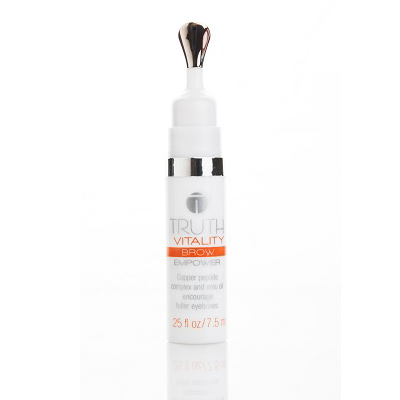
Over-plucked eyebrows should, theoretically, grow back if the follicles are given some TLC (which is what products such as Truth Vitality Brow Vitality Complex ($39 in the shop), with copper peptides and emu oil, are supposed to do). I regularly (approximately every other day) apply Brow Vitality Complex and my once-moth eaten brows are nicely filled in and the hairs are darker and thicker.
You do have to resign yourself to continued use of these products if you want to continue to have results. When you stop using an eyelash growth product, your growth cycle will revert back to normal. Plus, you may (depending on your age) need to counteract the post-42 thing.
As far as results go, this will vary from each person because of the genes that gave them their follicles and dictated the length of their growth cycles. And if you are lucky enough to start using a product during the telogen cycle, you might see results more quickly because you were just about to go into a growth period anyway.
Watch Marta's video in which she explores the reasons behind hair loss and offers solutions for stimulating the growth of healthy hair at any age:

Read more about Truth In Aging's Truth Vitality hair care collection:











 Loading...
September 8, 2017
by Tina
Hi, sounds very promising! I was learning about this topic for years. I know that my over-plucked eyebrows grew back naturally, but my cut and burned eyelashes didn't!.. For now I am using Cherish Lash serum for them and their condition/length is improving pretty fast, but maybe I should consider your product as well?? Btw my eyebrows became a bit less thick with age. So maybe I need your help indeed.
December 6, 2016
by Marta
Hi Vivian, yes the products work for African American hair.
December 6, 2016
by Vivian
Ooh I forgot to ask you can all yuor products be used on by African American women?
December 6, 2016
by Vivian
I have had a nervous tick for along time...which has made me keep on pulling out my eye lashes...and the nest thing you know I have none. Now I know this something that you might have heard of before ...but now that I have stopped pulling out them out and got some help with this problem...will you product work with my eye lashes and browse? Because I really have gotten tired of me walking around with no lashes and thin eye brows...
August 17, 2015
by Jess
Hi, have just read this article and what the heck is 'the post-42 thing'??? Have been searching for an answer to why my eyebrows all of a sudden are growing REALLY LONG.....any ideas? It only started over the last couple of weeks and my beautician even mentioned it when I went for a brow and lash tint the other day EEK! I'm not quite 42 yet though I feel much more than that at 38 with the naughtiest two year old twin boys!! :)
May 11, 2015
by elisa
Hi there. ..first of all, I would like tiothank you for the amazing article about hair cycle. I have a few question to ask you. First, I noticed my eyelashes keep falling these days, I've been washing my face gently and cleaning eye area gently and lightly but it still fall. Falls like about 3-4 lashes for one side of the eye.is this normal? Sometimes it totally din fall out in a day. Sometimes it falls out like one or two or three to four lashes. I'm getting a but worried as it keeps on falling everyday. I was told that it might be the life cycle of my eyelashes. So, I would like to know is it normal to have eyelashes falls out like 3 to 4 lashes in a day and if it really is life cycle, then when it stop? Will it grow back?
I have part of my eyebrow hair that I over plucked them back then and it's not ggrowing back after so manyyears.and each time I apply eyebrow liner, it falls too. Oh ya...I'm not everyday user of mascara.the last time I used was a month ago.a
March 1, 2015
by Marta
Hi Judy, I have created a line of products for hair and brow regrowth that use copper peptides as the active ingredient. You can get more information here: https://www.truthinaging.com/hair-care/truth-vitality
March 1, 2015
by judy
I am just starting to look for products that work for both lashes and brows. I am
61 and not happy how my brows and lashes are no more. I had chemo about 20 years ago and everything fell out and its not a pretty picture. Now age is having it's effect only this time I know the brows and lashes are not going to grow back unless there is some product out there that works. I would appreciate any recommendations you may have that could work for me.
Thank You
February 21, 2015
by Marta
Hi Jackie, we have a product to help brows grow called Brow Empower: https://www.truthinaging.com/truth-vitality-brow-empower
February 21, 2015
by Jackie
I'm 15 years old and in 7th grade i basically lost my eyebrows. It's been 2 years and they haven't grown at all, I'm kind of scared that they won't grow back and I'm really tired of coloring them in. Any tips or ways to help them grow ? I really need it !:(
January 27, 2015
by Marta
Hi Emma, it is a rather good question and it may depend on the active and the mechanism of how it works. For example, copper peptides work in two ways on the follicle: increasing follicle cell proliferation; and copper also decreases programmed follicle cell death. So in this case, copper would increase the life of the follicle - potentially.
January 27, 2015
by emma
I am just curious - If there is a limited life cycle of each follicle and eyelash growth products stimulate a faster growth cycle/switch on more follicles. Is there any danger using these sorts of growth products long term I will end up running out of follicles able to produce new eyelashes. (I am thinking kind of along the lines of the Hayflick limit and skin cells/using too much exfoliant for example ). Sorry if this is a stupid question!
December 23, 2014
by Natalie Crisson
Want to make your eyebrow growing then try to use BrowEffect Serum. I also used this product for 10 weeks. After about a month i noticed more hair growth, this may have been due to the fact that i didn't thread my eyebrows the whole time. I did notice that my brows were fuller and darker. Great product after continued use
October 7, 2014
by Marta
Hi Marge, you still have follicles, although they may be dormant. Emu oil in our Brow Empower wakes up dormant follicles and copper works on follicles to strengthen them. I would say it is worth a try, although it may take a few months to see results.
October 6, 2014
by Marge
7 or 8 years ago, rather suddenly my eyebrows began to thin, and soon I had no
eyebrows at all. My doctor and my dermatologist ran many tests, but no cause or reason was found. Eventually, I got permanent eyebrows (basically like
tattoos). They have faded to the point that I know have to use an eyebrow pencil
every day. I'm guessing there are no longer any hair follicles and that your product
would not help me. Your thoughts?
October 13, 2013
by Anna
Hi there,Im very upset that i seemed to shedding eye lashes only in one eye.Im very upset and depressed can you help?
September 15, 2013
by Marta
Brow Vitality Complex comes in a bottle which is an airless pump. It does not have a stem inside. This packaging prevents air getting to the product and contaminating it. Nicole, I believe that customer service has responded to you on this and will be more than happy to answer any other questions regarding your purchase so please email us at customerservice@truthinaging.com
September 14, 2013
by Nicole
Hey Marta! :)
I got the Brow Vitality, and i am so excited to use it!!
I do have a question though. When i had removed the pump from the bottle there was no stem inside that sends the product through the pump. For example, if i were to take the pump cap off a lotion bottle there would be a stem or plastic stick that sucks up the lotion so that way it pumps out of the bottle. Are the Brow Vitality bottles just designed that way?
I don't know if that made any sense but i was just asking cause i hope i didn't get a bad bottle or a rip off of the product.
September 11, 2013
by Nicole
Oh okay! and only use a small amount? like how you use with the copper?
I think the reason the my eyebrows were shedding a little more than normal is because i was putting a little more than i should with the Folligen Cream. But knowing that its that, i have cut back but i am so excited to try the Brow Vitality :)
Thank you so much again for answering my questions! Love this website such good help and i always get fast reply's :)
September 11, 2013
by Marta
Hi Nicole, I would wait a week before swapping to Brow Vitality. It is best used daily. I think the hairs should grow back - indeed, it sounds as if they are.
September 10, 2013
by Nicole
Ugh I am so sorry i forgot to ask one more thing :(
the hairs that have shed from my eyebrows if they have little tiny white bulbs on the end, they will grow back right? giving them time of course.
September 10, 2013
by Nicole
oh sorry to bother but one more question should i only apply brow vitality once a day? Or once every other day?
Thank you again Marta!! :)
September 10, 2013
by Nicole
Dear Marta,
So i have been using the Follegin cream and they have been making my eyebrows shed a lot more than normal. but i have been growing hair in areas that i have never had before and they are coming in thick! I am in general a VERY harry italian woman and my eyebrows have always seemed to grow back of course with "time." But i called skin biology which that is where i got my Follegin cream and they said that it is totally normal because new hair is coming in! so i was like oh good i am not allergic to it then.
But now i am going to try the Brow Vitality and see what it can do . I has asked if i should lean off the Follegin for about a week or three and then start the Brow Vitality. My eyebrows are growing in but they are patchy but i heard that is normal.
p.s. I just would like to say thank you for answering back and i REALLY appreciate it :)
Its nice to know that there is hope in getting my brows back.
-sincerely Nicole
September 5, 2013
by Marta
Hi Nicole
It is normal for all hair (head, brows and lashes) to go through a shedding period. I think your best bet, as you say, is leave well alone (no tweezing) for three weeks and see what happens. But hair growth products like Folligen and Brow Vitality (which has emu oil as well as copper peptides) should help reduce shedding and encourage growth. So, if you don't see any improvement by leaving them alone, try those products out.
September 5, 2013
by Nicole
Hello Marta I have a question! so I am currently regrowing my eyebrows i have been plucking since i was 13 but like an on and off kind of thing! So i bought the folligen cream and i am going to try it with emu oil. Now i think my eyebrows are going through a shedding phase but they have been shedding a lot you can't tell though. I don't know if i should be worried or not. But does the folligen cream really help with my eyebrows. I just don't want to lose them and i am getting some growth i havent touched them for three weeks i am seeing some progress if i leave them alone for three months will they grow back. By the way i just turned 21 and i hope that me still being young there is hope in my eyebrows growing back. Thanks for taking the time to read this :) Maybe i am freaking out for nothing.
August 12, 2013
by Nad
Hi Marta,
Very interesting article. For my case I have experiencing eyebrows hair loss since March 2013 until now, so 5 months. I used to have thick eyebrows and now i can see clearly they are thinning. I just pass a finger very gently on my eyebrows and I find 2 or 3 eyebrows hair on my fingers. I can lose like 8 to 10 ten hairs each day from each eyebrow. One dermatologist said I have Seborrhoeic dermatitis another one said I have Alopecia Areata. It should be noted that I am also losing easily hair from scalp but not so much. This eyebrow hair loss is worrying me A LOT. what could be the cause? can it be related to a disease?
I discovered recently that I have black mold in my AC unit, can this be the cause?
I look forward to hearing from you.
Many Thanks.
July 1, 2013
by Dannielle
I have question about my brows, I have always dI'd my own btows by plucking and at one point I was a over plucker. Well I stoped over plucking and got to the point were I was semi satisfied with them well I had some hairs grow in weird and I went to a professional threader who told me I need to grow them out for 6 months I was devastated because my eyebrows are very important to me and I couldn't imagine how awful they were going to look aftwr 6 months of no up keep. Well I last 2 months and finally broke and went and them waxed for the first time ever. Well that was a nightmare I end up witj two diffrent shaped eyebrows one was missing the first part half closet to the tear duck on the eye. So I had to wait a month for them to go back, finally they did and I had asked around about amyone that knew of a great waxer my hubbys cousion got me in touch with hers. So I went and seen her even being super nervous well it went well so I tjought I will go back to her again. So I went back when my eyebrows need a touch up. O my gosh she messed them up. One is longer then the other and she took off the hole end of my left side and left a gaping hole in my right. So its been about 3 half weeks since I have had them done and not seeing a hole lot of hair growing back in places that once grew back just fine and I am thinning in one area. Does this mean my hair is permanently goin and why would my hair be thinning in a spot? O ya and they itch is that normal also? Any help would be great please.
April 17, 2013
by Marta
Hi Iona, that's really interesting. I shall definitely do some more reading up on this. Thanks for the research - if you have any links to share, I'd be grateful
April 16, 2013
by Ilona Sophie
This article mentions how over-plucking eyebrows doesn't make sense. However after doing some more research, I believe that if a hair is being plucked out while in the anagen (growing) phase, it could possibly retard the growth in that follicle, as it was already in a growing stage and removing the hair causes confusion for the cycle of growth. If a hair is pulled out during telogen phase, it may have been ready to fall out soon anyway, and a new hair will most likely grow. I would love to know what your thoughts are on this.
June 20, 2012
by Chrissy
Hey I have a question about eyelash growth. My lashes are very short and missing in some areas, it would be really nice to have more eye lashes, is there a safe product that has a reasonable price that could help me? Also if I use a product just enough to see the results I want can I stop using it?
Thanks for your time in reading my questions...
-Chrissy
May 2, 2012
by Marta
Hi Anne-Sophie, I was discussing this with our contributor Nisha recently (I hope she will weigh in too) about this issue. We both experienced some heavier than usual shedding of eyelashes - mine stated just after I finished using a lash growth product by ReLuma. It lasted about a week, I stopped using anything (other than eye cream) and it settled down. My only explanation is that these products speed up the growth - and therefore, the shedding - cycles. My advice would be to give yourself a break for a month and then try out a new one. I personally would not go back to Nutraluxe Lash MD as it contains a prostaglandin derivative and this can have side effects for your eyes, not just lashes. You can read more here: <a href="http://www.truthinaging.com/eyes-eylashes-brows/skin-blends-lashes-ltd" rel="nofollow">http://www.truthinaging.com/eyes-eylashes-brows/skin-blends-lashes-ltd</a>
I have tested and reviewed prostaglandin free lash enhancers that work and are safe: see my Five Best here:<a href="http://www.truthinaging.com/reviewed-recommended-eyes/five-best-for-eyelash-and-brow-2011" rel="nofollow"> http://www.truthinaging.com/reviewed-recommended-eyes/five-best-for-eyelash-and-brow-2011</a>
May 1, 2012
by Anne-Sophie
Hi! I know it's been a long time since the article was published, but you seem like a very good source of information, and I need your advice!
Since November 2011, I've used Nutraluxe Lash Md serum. I've used 1 bottle completely, then begin to use the second one.
After the first bottle, my eyelashes were STUNNING. People would come to me like "If you're not wearing false lashes I need to know your secret". They were not believing me it was my own lashes!
Then, I started the second bottle. I was so impressed with the results, I wanted to maintain my pretty lashes! So I continued using it. 2 weeks after, my lashes were so long I could not apply mascara the right way. My lashes would touch my eyebrows and the sides of my nose. It was the longest lashes I've seen in my life. I continued to put my serum every night. Then the week after, the drama began.
I started loosing eyelashes, it was crazy. (And I don't exaggerate, it was a MESS.) I was removing my makeup at night and there was a dozen of lashes falling every day. I panicked, the reaction I had was to continue to use the serum so that my eyelashes grow faster! But my lashes were still falling. So after 10 days in this situation, I stopped using my serum.
I still loose about 4-5 lashes a day. My lashes are so short now! I have about 10 long eyelashes, and the other lashes are the tiniest lashes I've ever had. I used to have natural long eyelashes.
So what should I do according to you? Use the serum again? Continue not to use it? Put no mascara on my lashes for a few weeks so they grow back faster?
Will they grow back just the way they were? Cause now they are more little than they were normally.
I hope somebody will help me :(
Anne-Sophie
August 22, 2010
by martin
"And if you are lucky enough to start using a product during the telogen cycle, you might see results more quickly because you were just about to go into a growth period anyway."
contradicts
"The phasing of the growth cycle is staggered amongst the follicles. Which prevents us from periodic phases of baldness when the growth cycle stops."
October 10, 2009
by marta
Laura, there are several good eyelash growth products that do not have prostaglandins. See our <a href="http://www.truthinaging.com/uncategorized/five-best-eyelash-and-brow-growth-products/" rel="nofollow">Five Best</a> suggestions and there is also <a href="http://www.truthinaging.com/eyes/hydropeptide-lash-helps-eyelashes-grow-tested-and-recommended/" rel="nofollow">Hydropeptide</a>, which I am personally using and have found it is safe and works. And we have a <a href="http://www.truthinaging.com/eyes/eyelash-growth-products-are-they-safe-and-do-they-work-2009-update/" rel="nofollow">roundup of all the eyelash products</a> and if they are safe and work.
October 10, 2009
by Laura
I'm worried about using a lash product, as I don't want to damage my eyes. But vanity and the desire for long eyelashes is a huge draw to a eyelash enhancing product. Which product would you suggest?, and is it necessary to use a prostaglandin in the eyelash enhancing solution? Thx
July 4, 2009
by Michelle
Hm,
Yeah, we might want to consider JLL says about the number of hair follicles because I actually noticed a bit more eyelash growth along with length and darkness while using Revitalash. Or maybe I'm just imagining things, but I think I did grow some more lashes (not sure about the thickness, but perhaps quantity/volume). The same for Folligen, but I only noticed a few eyelash hairs growing, and then it stopped.
July 2, 2009
by marta
Lumigan is marketed as Latisse for cosmetic use. The active is a prostaglandin, which we've written about many times. You can see which products use it in our <a href="//www.truthinaging.com/eyes/eyelash-growth-products-are-they-safe-and-do-they-work-2009-update/" rel="nofollow">eyelash product roundup.</a>
July 2, 2009
by JLL
"If I’ve understood your wonderful hair growth 101 post, then I have to accept that I’ll never have bushy lash’s from any growth product I use. 1 follicle, 1 hair. Doesn’t sound likely that a growth product will make 6 or 12 hairs grow out of 1 follicle!"
Some compounds can also increase the number of hair follicles. See the link for some studies.
July 1, 2009
by JoeActionHero
this doesn't address how products like Lumigan work.
June 6, 2009
by Lynda
I have been using LiBrow for almost 2 months and, believe it or not, I can see eyebrow regrowth. I overplucked my brows for many years and had almost given up hope of ever having eyebrows again. It is a little pricey, but it is better than paying between $3,000 and $5,000 for a transplant. Oh, by the way, you can also get LiLash to have longer, fuller eyelashes.
March 12, 2009
by marta
I have been using both over these months. I've probably used Dermalash in a more sustained way and it definitely works. As it has now run out I am using Folligen consistently (and will post a video on how to apply it shortly).
March 12, 2009
by LashFan
Marta,
I've been following your posts for a while. It's been a while since you started using Folligen and Dermalash. What were your results after several months? And what's your current fave eyelash growth product?
March 2, 2009
by Melanie
Hey,
I would really love to get longer eyelashes. If you have any tips i'd really love to hear them. ha and as for the eyebrows i want to keep them from growing but i know that wont happen.
THANKS! melanie
February 20, 2009
by marta
Nhan,
Follicle stimulation is a good thing. With a shampoo, you'd have to make sure there was a bone fide active ingredient in a high enough concentration. I would still use something like Folligen for the best results.
February 18, 2009
by Junko
Marta,
If I've understood your wonderful hair growth 101 post, then I have to accept that I'll never have bushy lash's from any growth product I use. 1 follicle, 1 hair. Doesn't sound likely that a growth product will make 6 or 12 hairs grow out of 1 follicle! I'm a bit bummed, but at least I'm thinking about eyelash growth more realistically, due to your class. Would explain why my results mirror Copley's in using the Revitalash. Longer yes - but not more plentiful. Thanks for keeping our feet on the ground and reminding us about the science behind it all. Otherwise we will continue to think that these potions are just MAGIC and have totally unrealistic expectations of them!
February 8, 2009
by Nhan
Thank you for this is amazing information! I heard that if you use a type of shampoo that helps stimulate your follicles then your hair grows out more, is that true?